
Minnesota Homes Today Local & National News

  • Home
  • About Us
  • Blog
  • Resources
    • Buyers Guide
    • Sellers Guide
    • Buyer Info
    • Seller Info
    • Closing Costs
    • Home Appraisal
    • Home Inspection
    • Loan Checklist
    • Loan Process
    • Loan Programs
  • Contact

Mortgage 101: How Interest-Only Mortgages Work and Why They’re A Good Solution for Some Buyers

November 15, 2022 by Bob Elliot

Mortgage 101: How Interest-Only Mortgages Work and Why They're A Good Solution for Some BuyersWhether you’re a first-time homebuyer or an experienced real estate investor, if you are planning to borrow funds to buy a home you will want to choose the right mortgage product. In today’s blog post we’ll explore how interest-only mortgages work and why they’re the perfect choice for some homebuyers.

How Interest-Only Mortgages Differ From Conventional Ones

As the name suggests, interest-only mortgages are loans where you are only required to pay off the interest portion of the loan each month for some specific term. The length of these loans can be up to ten years, although five or seven is the most common. Once this period is over, you will have some options. Some choose to refinance their mortgage into a new term; others will make a lump-sum payment to pay off the balance. The most important item of note is that during the interest-only period, no principal is paid off unless you pay a bit extra.

The Pros And Cons Of Interest-Only Mortgages

Interest-only mortgages are a popular choice because of their many upsides. Your monthly payments are almost certainly going to be far lower during the interest-only period. This is because you’re not responsible for paying down the principal of the loan. A lower monthly payment frees up money that you can use for other purposes, such as investing. Also, your entire monthly payment during the interest-only period should be tax deductible, which may contribute to a refund each year.

Note that there are some potential downsides to interest-only mortgages as well. For example, if your mortgage interest rate is adjustable, you can end up paying more in interest than if you had locked in. You also need to stay disciplined financially. Once the interest-only period ends, your monthly payment may increase significantly to cover both interest and principal.

Who Should Consider An Interest-Only Mortgage?

Interest-only mortgages are a good fit for those individuals or families where you are confident that your income is going to grow significantly in five or ten years. Alternatively, if your income is somewhat sporadic and you want the option of paying lower payments in some months and more substantial payments in others. The key point is that these mortgages offer flexibility that other mortgage products do not.

As you can see, interest-only mortgages are an excellent choice in certain circumstances. To learn more about how an interest-only mortgage might be right for you, contact our professional mortgage team today. We are happy to share our experience to find mortgage financing that perfectly suits your needs.

Filed Under: Home Mortgage Tips Tagged With: Home Mortgage Tips, mortgage, mortgage rates

Home Equity: A Source of Strength for Homeowners Today

November 14, 2022 by Bob Elliot Leave a Comment

Home Equity: A Source of Strength for Homeowners Today

Home Equity: A Source of Strength for Homeowners Today | MyKCM

Experts agree there’s no chance of a large-scale foreclosure crisis like we saw back in 2008, and that’s good news for the housing market. As Mark Fleming, Chief Economist at First American, says:

“. . . don’t expect a housing bust like the mid-2000s, as lending standards in this housing cycle have been much tighter and homeowners have historically high levels of home equity, so there likely won’t be a surge in foreclosures.”

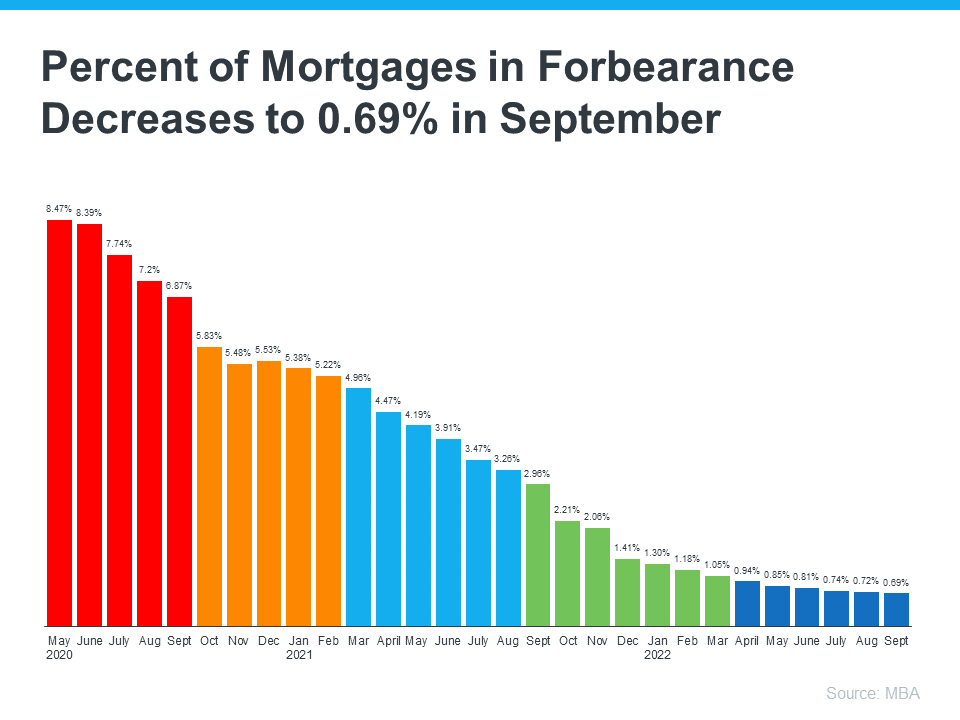
Data from the Mortgage Bankers Association (MBA) helps tell this story. It shows the overall percentage of homeowners at risk is decreasing significantly with time (see graph below):

Home Equity: A Source of Strength for Homeowners Today | MyKCM

But even though the volume of homeowners at risk is very low, there is still a small percentage of homeowners who may be coming face to face with foreclosure as a possibility today. If you’re facing difficulties yourself, it can help to understand your options. It starts with knowing what foreclosure is. Investopedia defines it like this:

“Typically, default is triggered when a borrower misses a specific number of monthly payments . . . Foreclosure is the legal process by which a lender attempts to recover the amount owed on a defaulted loan by taking ownership of and selling the mortgaged property.”

The good news is there are alternatives available to help you avoid going through the foreclosure process, including:

  • Reinstatement
  • Loan modification
  • Deed-in-lieu of foreclosure
  • Short sale

But before you go down any of those paths, it’s worth seeing if you have enough equity in your home to sell it and protect your investment.

You May Be Able To Use Your Equity To Sell Your House

Equity is the difference between what you owe on the home and its market value based on factors like price appreciation.

In today’s real estate market, many homeowners have far more equity in their homes than they realize due to the home price appreciation we’ve seen over the past few years. According to CoreLogic:

“The total average equity per borrower has now reached almost $300,000, the highest in the data series.”

So, what does that mean for you? If you’ve lived in your house for at least a few years or more, chances are your home’s value, and your equity, has risen dramatically. In addition, the mortgage payments you’ve made during that time chipped away at the balance of your loan. If your home’s current value is higher than what you still owe on your loan, you may be able to use that increase to your advantage.

Rick Sharga, Executive VP of Market Intelligence at ATTOM Data, explains how equity can help:

“Very few of the properties entering the foreclosure process have reverted to the lender at the end of the foreclosure. . . We believe that this may be an indication that borrowers are leveraging their equity and selling their homes rather than risking the loss of their equity in a foreclosure auction.”

Lean on Experts To Explore Your Options

To find out how much equity you have, work with a local real estate professional. They can give you an estimate of what your house could sell for based on recent sales of similar homes in your area. You may be able to sell your house to avoid foreclosure.

If you find out you have to pursue other options, your agent can help with that too. They’ll be able to connect you with other professionals in the industry, like housing counselors, who can look into your unique situation and offer advice on next steps if selling isn’t your best alternative.

Bottom Line

If you’re a homeowner facing hardship, let’s connect so you have an expert on your side to explore your options and see if you can sell your house to avoid foreclosure.

Filed Under: Home Equity Tagged With: Home Buying, Home Equity, Housing Market

What’s Ahead for Mortgage Rates This Week – November 14, 2022

November 14, 2022 by Bob Elliot

What's Ahead For Mortgage Rates This Week - November 14, 2022Last week’s scheduled economic news included readings on monthly and year-over-year inflation and the University of Michigan’s preliminary reading on consumer sentiment. Weekly readings on mortgage rates and jobless claims were also released.

Consumer Price Index: Inflation Shows Signs of Slowing

Government readings on October inflation showed signs of stabilizing and even slowing. The Consumer Price Index for October showed month-to-month inflationary growth of 0.40 percent as compared to the expected reading of 0.60 percent and September’s reading of 0.40 percent growth. Year-over-year inflation rose by 7.70 percent as compared to the expected reading of 7.90 percent and September’s reading of 8.20 percent.

Month-to-month core inflation, which excludes volatile food and fuel sectors, rose 0.30 percent in October as compared to expectations of 0.50 percent growth and September’s reading of 0.60 percent growth. Year-over-year core inflation rose 6.30  percent; analysts expected year-over-year core inflationary growth of 6.50 percent. September’s year-over-year reading for core inflation was 6.60 percent. The Federal Reserve considers year-over-year inflation of two percent as normal.

Mortgage Rates, Jobless Claims Rise

Freddie Mac reported higher mortgage rates last week as rates for 30-year fixed-rate mortgages averaged 7.08 percent and 13 basis points higher than for the previous week. Rates for 15-year fixed-rate mortgages rose nine basis points and averaged 6.38 percent. Rates for 5/1 adjustable rate mortgages averaged 6.06 percent and 11 basis points higher than for the previous week. Discount points averaged 0.90 percent for 30-year fixed-rate mortgages and 1.00  percent for 15-year fixed-rate mortgages. Points for 5/1 adjustable rate mortgages averaged 0.20 percent

Initial jobless claims rose last week with 225,000 new claims filed as compared to 220,000 new claims expected and  218,000 first-time jobless claims filed. in the previous week. 1.49 million continuing jobless claims were reported, which matched the previous week’s reading.

The University of Michigan released its preliminary consumer sentiment survey for November with an index reading of 54.7. Analysts expected a reading of 59.5 for November; October’s reading was 59.9. Index readings over 50 indicate that most survey participants view current economic conditions as positive.

What’s Ahead

This week’s scheduled economic reporting includes readings on housing markets, sales of previously-owned homes, government reports on housing starts, and building permits issued. Weekly readings on mortgage rates and jobless claims will also be released.

Filed Under: Financial Reports Tagged With: Case-Shiller, Financial Report, Interest Rates Rise, Jobless Claims

  • « Previous Page
  • 1
  • …
  • 104
  • 105
  • 106
  • 107
  • 108
  • …
  • 1133
  • Next Page »

Connect with Me!

Let’s Keep In Touch!

  • This field is for validation purposes and should be left unchanged.

Quick Links

  • About Me
  • Accessibility Statement
  • Blog
  • Contact

Looking For Something?

Categories

Copyright © 2025 · Powered by MySMARTblog

Copyright © 2025 · Genesis Sample Theme on Genesis Framework · WordPress · Log in