
Minnesota Homes Today Local & National News

  • Home
  • About Us
  • Blog
  • Resources
    • Buyers Guide
    • Sellers Guide
    • Buyer Info
    • Seller Info
    • Closing Costs
    • Home Appraisal
    • Home Inspection
    • Loan Checklist
    • Loan Process
    • Loan Programs
  • Contact

What’s Ahead for Home Prices?

October 21, 2022 by Bob Elliot Leave a Comment

What’s Ahead for Home Prices? | MyKCM

As the housing market cools in response to the dramatic rise in mortgage rates, home price appreciation is cooling as well. And if you’re following along with headlines in the media, you’re probably seeing a wide range of opinions calling for everything from falling home prices to ongoing appreciation. But what’s true? What’s most likely to happen moving forward?

While opinions differ, the most likely outcome is we’ll fall somewhere in the middle of slight appreciation and slight depreciation. Here’s a look at the latest expert projections so you have the best information possible today.

What the Experts Are Saying About Home Prices Next Year

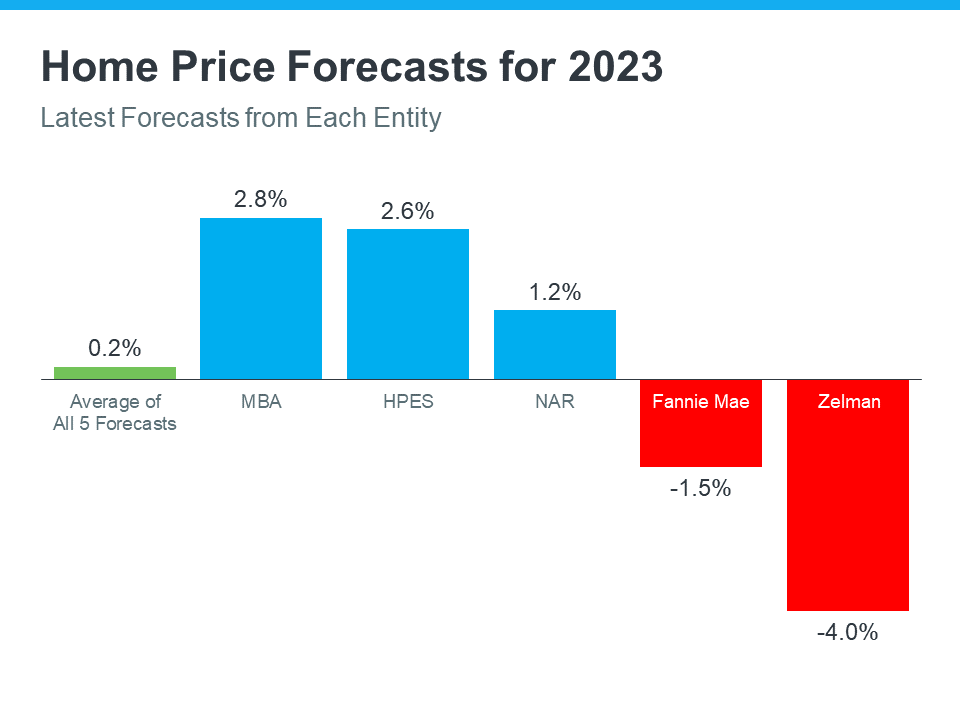
The graph below shows the most up-to-date forecasts from five experts in the housing industry. These are the experts that have most recently updated their projections based on current market trends:
What’s Ahead for Home Prices? | MyKCM

As the graph shows, the three blue bars represent experts calling for ongoing home price appreciation, just at a more moderate rate than recent years. The red bars on the graph are experts calling for home price depreciation.

While there isn’t a clear consensus, if you take the average (shown in green) of all five of these forecasts, the most likely outcome is, nationally, home price appreciation will be fairly flat next year.

What Does This Mean?

Basically, experts are divided on what’s ahead for 2023. Home prices will likely depreciate slightly in some markets and will continue to gain ground in others. It all depends on the conditions in your local market, like how overheated that market was in recent years, current inventory levels, buyer demand, and more.

The good news is home prices are expected to return to more normal levels of appreciation rather quickly. The latest forecast from Wells Fargo shows that, while they feel prices will fall in 2023, they think prices will recover and net positive in 2024. That forecast calls for 3.1% appreciation in 2024, which is a number much more in line with the long-term average of 4% annual appreciation.

And the Home Price Expectation Survey (HPES) from Pulsenomics, a poll of over one hundred industry experts, also calls for ongoing appreciation of roughly 2.6 to 4% from 2024-2026. This goes to show, even if prices decline slightly next year, it’s not expected to be a lasting trend.

As Jason Lewris, Co-Founder and Chief Data Officer for Parcl, says:

“In the absence of trustworthy, up-to-date information, real estate decisions are increasingly being driven by fear, uncertainty, and doubt.”

Don’t let fear or uncertainty change your plans. If you’re unsure about where prices are headed or how to make sense of what’s going on in today’s housing market, reach out to a local real estate professional for the guidance you need each step of the way.

Bottom Line

The housing market is shifting, and it’s a confusing place right now. Let’s connect so you have a trusted real estate professional to help you make confident and informed decisions about what’s happening in our market.

Filed Under: Home Prices Tagged With: Home Prices, Housing Market, Inflation

Should You Still Buy a Home with the Latest News About Inflation?

October 21, 2022 by Bob Elliot Leave a Comment

Should You Still Buy a Home with the Latest News About Inflation? | MyKCM

While the Federal Reserve is working hard to bring down inflation, the latest data shows the inflation rate is still high, remaining around 8%. This news impacted the stock market and added fuel to the fire for conversations about a recession.

You’re likely feeling the impact in your day-to-day life as you watch the cost of goods and services climb. The pinch it’s creating on your wallet and the looming economic uncertainty may leave you wondering: “should I still buy a home right now?” If that question is top of mind for you, here’s what you need to know.

Homeownership Is Historically a Great Hedge Against Inflation

In an inflationary economy, prices rise across the board. Historically, homeownership is a great hedge against those rising costs because you can lock in what’s likely your largest monthly payment (your mortgage) for the duration of your loan. That helps stabilize some of your monthly expenses. James Royal, Senior Wealth Management Reporter at Bankrate, explains:

“A fixed-rate mortgage allows you to maintain the biggest portion of housing expenses at the same payment. Sure, property taxes will rise and other expenses may creep up, but your monthly housing payment remains the same.”

And with rents being as high as they are, the ability to stabilize your monthly payments and protect yourself from future rent hikes may be even more important. Lawrence Yun, Chief Economist at the National Association of Realtors (NAR), explains what happened to rents in the latest inflation report:

“Inflation refuses to budge. In September, consumer prices rose by 8.2%. Rents rose by 7.2%, the highest pace in 40 years.”

When you rent, your monthly payment is determined by your lease, which typically renews on an annual basis. With inflation high, your landlord may be more likely to increase your payments to offset the impact of inflation. That may be part of the reason why a survey from realtor.com shows 72% of landlords said they plan to raise the rent on one or more of their properties in the next year.

Becoming a homeowner, if you’re ready and able to do so, can provide lasting stability and a reliable shelter in times of economic uncertainty.

Bottom Line

The best hedge against inflation is a fixed housing cost. If you’re ready to learn more and start your journey to homeownership, let’s connect.

Filed Under: Home Buyer, Uncategorized Tagged With: Home Buying, Homeownership, Inflation

What to Know About Flood Insurance

October 20, 2022 by Bob Elliot

What To Know About Flood InsuranceFlooding can happen in any location at any time. Even though many people associate floods with coastal properties, flooding can take place inland as well. That is why you always need to take a look at the map to figure out whether your property is located in a flood zone. There are some situations where your lender might require you to purchase flood insurance. What do you need to know?

What Is Protected and What Is Not?

When you purchase flood insurance, there are three broad components that you should examine. You need to check and see whether the policy covers the building, the contents of your home, and potential replacement expenses. Flood insurance policies generally insure any physical damage done to your house as well as any belongings you have inside your home. This might include your walls, household appliances, plumbing system, electrical system, clothing, and furniture.

On the other hand, most flood insurance policies do not cover your outdoor structures. For example, they will not protect your patio, swimming pool, fence, or vehicles parked outside the home.

What Is Your Flood Risk Level?

Your flood insurance premium will vary depending on where you are located. For example, if you are in a flood zone, your flood insurance premiums will probably be significantly higher; however, a significant percentage of flood claims occur in areas that are not located in a flood plain. While your premium should be lower, you may want to talk to your real estate agent to see whether it is worth it to purchase flood insurance.

Is Flood Insurance Required?

Flood insurance has its limitations, just like any other insurance policy. Therefore, you might be wondering whether it is required.

If it is required, it would be required by your lender. If your house is located in a flood zone, there is a significant chance that your lender will require you to purchase flood insurance as a requirement for financing. If you refuse to purchase flood insurance, then your lender might refuse to finance your property. You should always compare flood insurance premiums across different companies before you decide which one to go with. Be sure to compare policy coverage options and limitations as well.

Filed Under: Mortgage Tips Tagged With: Flood, flood insurance, Insurance

  • « Previous Page
  • 1
  • …
  • 114
  • 115
  • 116
  • 117
  • 118
  • …
  • 1133
  • Next Page »

Connect with Me!

Let’s Keep In Touch!

  • This field is for validation purposes and should be left unchanged.

Quick Links

  • About Me
  • Accessibility Statement
  • Blog
  • Contact

Looking For Something?

Categories

Copyright © 2025 · Powered by MySMARTblog

Copyright © 2025 · Genesis Sample Theme on Genesis Framework · WordPress · Log in