If you’re following along with the news today, you’ve likely heard about rising inflation. You’re also likely feeling the impact in your day-to-day life as prices go up for gas, groceries, and more. These rising consumer costs can put a pinch on your wallet and make you re-evaluate any big purchases you have planned to ensure they’re still worthwhile.
If you’ve been thinking about purchasing a home this year, you’re probably wondering if you should continue down that path or if it makes more sense to wait. While the answer depends on your situation, here’s how homeownership can help you combat the rising costs that come with inflation.
Homeownership Offers Stability and Security
Investopedia explains that during a period of high inflation, prices rise across the board. That’s true for things like food, entertainment, and other goods and services, even housing. Both rental prices and home prices are on the rise. So, as a buyer, how can you protect yourself from increasing costs? The answer lies in homeownership.
Buying a home allows you to stabilize what’s typically your biggest monthly expense: your housing cost. If you get a fixed-rate mortgage on your home, you lock in your monthly payment for the duration of your loan, often 15 to 30 years. James Royal, Senior Wealth Management Reporter at Bankrate, says:
“A fixed-rate mortgage allows you to maintain the biggest portion of housing expenses at the same payment. Sure, property taxes will rise and other expenses may creep up, but your monthly housing payment remains the same.”
So even if other prices rise, your housing payment will be a reliable amount that can help keep your budget in check. If you rent, you don’t have that same benefit, and you won’t be protected from rising housing costs.
Use Home Price Appreciation to Your Benefit
While it’s true rising mortgage rates and home prices mean buying a house today costs more than it did a year ago, you still have an opportunity to set yourself up for a long-term win. Buying now lets you lock in at today’s rates and prices before both climb higher.
In inflationary times, it’s especially important to invest your money in an asset that traditionally holds or grows in value. The graph below shows how home price appreciation outperformed inflation in most decades going all the way back to the seventies – making homeownership a historically strong hedge against inflation (see graph below):
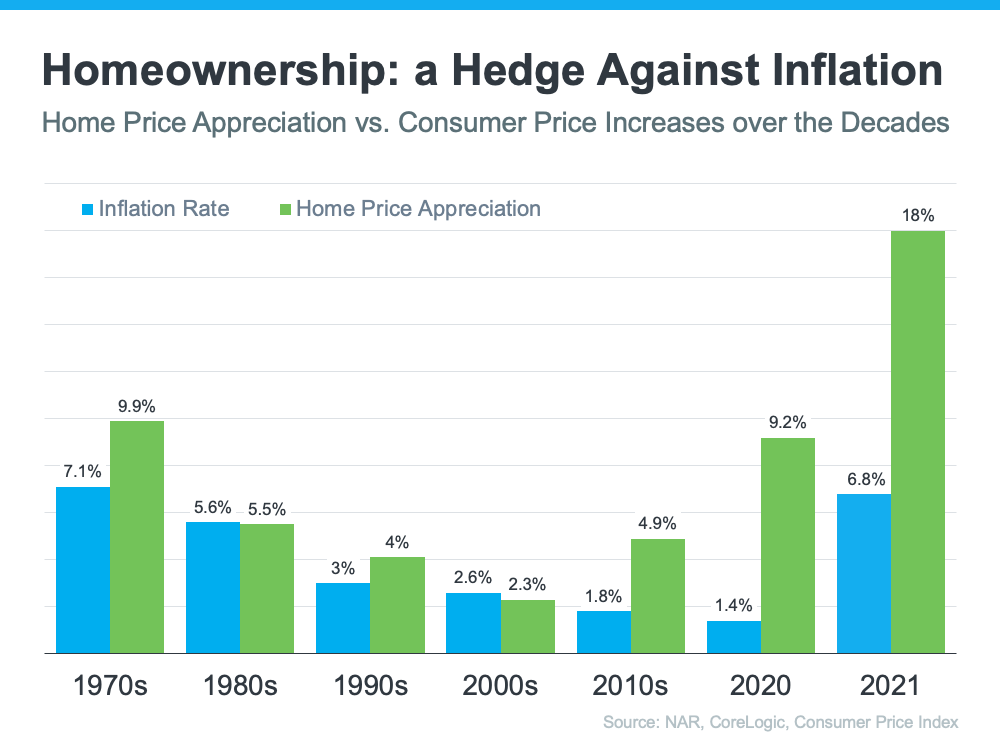
So, what does that mean for you? Today, experts say home prices will only go up from here thanks to the ongoing imbalance in supply and demand. Once you buy a house, any home price appreciation that does occur will be good for your equity and your net worth. And since homes are typically assets that grow in value (even in inflationary times), you have peace of mind that history shows your investment is a strong one.
Bottom Line
If you’re ready to buy a home, it may make sense to move forward with your plans despite rising inflation. If you want expert advice on your specific situation and how to time your purchase, let’s connect.
 S&P Case-Shiller’s National Home Price Index rose by 19.80 percent year-over-year in February and was the third-largest pace of home price growth since the National Home Price Index’s inception. The 20-City Home Price Index reported that Phoenix, Arizona held its first-place ranking with year-over-year home price growth of 32.90 percent. Tampa, Florida maintained its second-place standing with year-over-year home price growth of 32.60 percent. Miami, Florida reported year-over-year home price growth of 29.70 percent year-over-year. Home prices rose faster for all 20 cities in February than in January.
 The traditional rule of thumb is that you should put down 20 percent of the cost of the house if you decide to become a homeowner. Unfortunately, the thought of saving 20 percent of the price of a home for a down payment can be daunting for people who are trying to buy a house for the first time. If you purchase a house worth $250,000, this means that you would have to save up $50,000 to put down. Fortunately, there are multiple down payment assistance programs that can make it easier for people to afford a home.