
Minnesota Homes Today Local & National News

  • Home
  • About Us
  • Blog
  • Resources
    • Buyers Guide
    • Sellers Guide
    • Buyer Info
    • Seller Info
    • Closing Costs
    • Home Appraisal
    • Home Inspection
    • Loan Checklist
    • Loan Process
    • Loan Programs
  • Contact

What’s Ahead For Mortgage Rates This Week – November 8, 2021

November 8, 2021 by Bob Elliot Leave a Comment

What's Ahead For Mortgage Rates This Week - November 8, 2021Last week’s economic news included FHFA’s pending announcement of new conforming loan limits for single-family mortgages sold to or guaranteed by Fannie Mae and Freddie Mac and the Federal Reserve’s Federal Open Market Committee’s post-meeting statement. Weekly readings on mortgage rates and jobless claims were also released.

Mortgage Lenders Anticipate FHFA Increase in Conforming Loan Limits

The Federal Housing Finance Agency has not officially announced its conforming loan limits for single-family homes in 2022, but that hasn’t stopped some lenders from raising their loan limits from 2021’s maximum conforming loan limit of $548,250 to the expected maximum loan limit of $625,000 for mortgages on single-family homes. FHFA defines single-family homes as one-to-four-family residences.

FHFA oversees Fannie Mae and Freddie Mac and determines their lending policies and requirements for purchasing or securitizing mortgage loans from approved lenders. FHFA is expected to announce 2022 limits for conforming single-family loans sometime in November. Raising loan limits will accommodate rapid increases in home prices and enable lenders to originate conventional mortgages without additional costs associated with “jumbo” loans, which exceed the conforming loan limit. 

Fed Policymakers Leave Key Rate Range Unchanged

The Federal Open Market Committee of the Federal Reserve did not raise the key federal interest rate range of 0.00 to 0.25 percent, but members agreed that accommodative monetary policy will be phased out by reducing upcoming purchases of Treasury bonds and mortgage-backed securities. The Fed is also expected to raise its key interest rate, with two or more rate hikes possible in 2022 to 2023. Fed Chair Jerome Powell emphasized that accommodative measures will no longer be needed if the economy continues to grow at its current pace. Mr. Powell also said that the Fed will adjust monetary policy as needed based on changing conditions.

Mortgage Rates, Jobless Claims Fall

Freddie Mac reported lower mortgage rates last week; the average rate for 30-year fixed-rate mortgages was five basis points lower at 3.09 percent. Rates for 15-year fixed-rate mortgages averaged two basis points lower at 2.35 percent. The average rate for 5/1 adjustable rate mortgages was 2.54 percent and two basis points lower than in the prior week.

New jobless claims fell to 269,000 initial claims filed from the prior week’s reading of 283,000 claims filed. Analysts expected 275,000 initial jobless claims to be filed. Continuing jobless claims were also lower last week; 2.11 million ongoing claims were filed as compared to the prior week’s reading of 2.24 million continuing jobless claims filed.

What’s Ahead

This week’s scheduled economic reporting includes readings on inflation and weekly reports on mortgage rates and jobless claims.

Filed Under: Market Outlook, Mortgage, Mortgage Rates Tagged With: Market Outlook, mortgage rates

FOMC Statement: Fed Policymakers Discuss Easing Accommodations as Economy Improves

November 5, 2021 by Bob Elliot

FOMC Statement: Fed Policymakers Discuss Easing Accommodations as Economy ImprovesThe Federal Reserve’s Federal Open Market Committee considered easing monetary accommodations implemented in response to stronger economic conditions according to its post-meeting statement issued November 3. The Fed started making trillions in monthly bond purchases when the pandemic started but slowed its purchasing pace to $120 billion per month in June 2020. The Fed will soon reduce its monthly bond purchases to $105 billion monthly.

The Fed said it will continue to purchase bonds until the economy makes “substantial progress” toward its legally mandated goals of achieving two percent inflation and maximum employment. Supply shortages and high demand for goods caused by the pandemic have impacted the overall economy, but labor markets have suffered disproportionately. Pandemic-driven quits and retirements have left many job openings that remain unfilled.  Service-related jobs in hospitality and travel have been especially hard-hit as consumers continued to stay home.

Fed Calls High Inflation “Transitory”

Federal Reserve policymakers continued to call current higher-than-expected inflation “transitory,” but did not explain how long high inflation is expected to last. Supply-chain logjams continued to negatively impact supply and demand for goods and services; in some cases, high demand and short supplies drove inflation higher: “Inflation is elevated, largely reflecting factors that are expected to be transitory. Supply and demand imbalances related to the pandemic and the reopening of the economy have contributed to sizable price increases in some sectors.”

FOMC members did not raise the current benchmark interest rate range of 0.00 to 0.25 percent, but financial markets expect two or more rate hikes in 2022.

Fed Chair Expects Inflation to Remain High into Mid-2022

Fed Chair Jerome Powell commented on high inflation during a press conference given after the FOMC post-meeting statement: “Our baseline expectation is that supply chain bottlenecks and shortages will persist well into next year and elevated inflation as well.” Chair Powell continued: “As the pandemic eases, supply chain issues will abate and growth will move up. As that happens, inflation will decline from today’s elevated levels.”

Mr. Powell further commented that he expected labor markets to strengthen as the delta variant of the covid virus continues to decline.

Filed Under: Financial Reports Tagged With: Fed Report, Financial Report, Inflation

Why a Wave of Foreclosures Is Not on the Way

November 4, 2021 by Bob Elliot Leave a Comment

Why a Wave of Foreclosures Is Not on the Way | MyKCM

With forbearance plans coming to an end, many are concerned the housing market will experience a wave of foreclosures similar to what happened after the housing bubble 15 years ago. Here are a few reasons why that won’t happen.

There are fewer homeowners in trouble this time

After the last housing crash, about 9.3 million households lost their homes to a foreclosure, short sale, or because they simply gave it back to the bank.

As stay-at-home orders were issued early last year, the fear was the pandemic would impact the housing industry in a similar way. Many projected up to 30% of all mortgage holders would enter the forbearance program. In reality, only 8.5% actually did, and that number is now down to 2.2%.

As of last Friday, the total number of mortgages still in forbearance stood at  1,221,000. That’s far fewer than the 9.3 million households that lost their homes just over a decade ago.

Most of the mortgages in forbearance have enough equity to sell their homes

Due to rapidly rising home prices over the last two years, of the 1.22 million homeowners currently in forbearance, 93% have at least 10% equity in their homes. This 10% equity is important because it enables homeowners to sell their homes and pay the related expenses instead of facing the hit on their credit that a foreclosure or short sale would create.

The remaining 7% might not have the option to sell, but if the entire 7% of those 1.22 million homes went into foreclosure, that would total about 85,400 mortgages. To give that number context, here are the annual foreclosure numbers for the three years leading up to the pandemic:

  • 2017: 314,220
  • 2018: 279,040
  • 2019: 277,520

The probable number of foreclosures coming out of the forbearance program is nowhere near the number of foreclosures that impacted the housing crash 15 years ago. It’s actually less than one-third of any of the three years prior to the pandemic.

The current market can absorb listings coming to the market

Why a Wave of Foreclosures Is Not on the Way | MyKCM

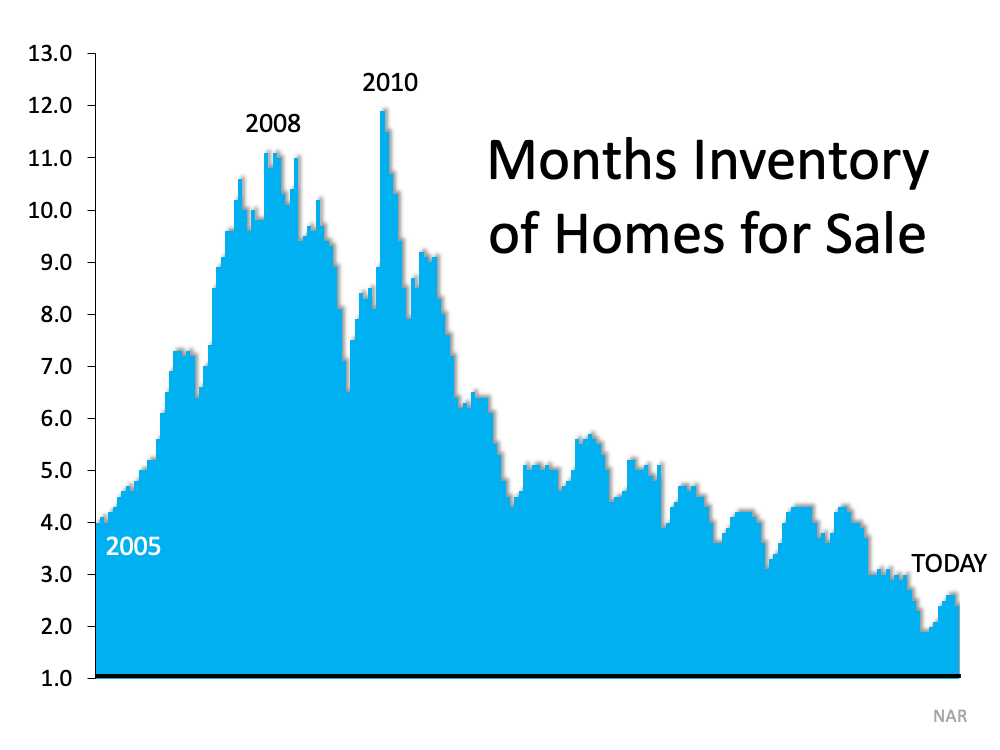
When foreclosures hit the market back in 2008, there was an oversupply of houses for sale. It’s exactly the opposite today. In 2008, there was over a nine-month supply of listings on the market. Today, that number is less than a three-month supply. Here’s a graph showing the difference between the two markets.

Bottom Line

The data indicates why Ivy Zelman, founder of the major housing market analytical firm Zelman and Associates, was on point when she stated:

“The likelihood of us having a foreclosure crisis again is about zero percent.”

Filed Under: Foreclosure Tagged With: Foreclosures, Home Buying, Housing Market

  • « Previous Page
  • 1
  • …
  • 228
  • 229
  • 230
  • 231
  • 232
  • …
  • 1133
  • Next Page »

Connect with Me!

Let’s Keep In Touch!

  • This field is for validation purposes and should be left unchanged.

Quick Links

  • About Me
  • Accessibility Statement
  • Blog
  • Contact

Looking For Something?

Categories

Copyright © 2026 · Powered by MySMARTblog

Copyright © 2026 · Genesis Sample Theme on Genesis Framework · WordPress · Log in