
Minnesota Homes Today Local & National News

  • Home
  • About Us
  • Blog
  • Resources
    • Buyers Guide
    • Sellers Guide
    • Buyer Info
    • Seller Info
    • Closing Costs
    • Home Appraisal
    • Home Inspection
    • Loan Checklist
    • Loan Process
    • Loan Programs
  • Contact

Why Buying a Home Makes More Sense Than Renting Today

May 1, 2023 by Bob Elliot Leave a Comment

Wondering if you should continue renting or if you should buy a home this year? If so, consider this. Rental affordability is still a challenge and has been for years. That’s because, historically, rents trend up over time. Data from the Census shows rents have been climbing pretty steadily since 1988.

And, data from the latest rental report from Realtor.com shows rents continue to grow today, even though it’s at a slower pace than we saw at the height of the pandemic:

“In March 2023, the U.S. rental market experienced single-digit growth for the eighth month in a row . . . The median asking rent was $1,732, up by $15 from last month and down by $32 from the peak but is still $354 (25.7%) higher than the same time in 2019 (pre-pandemic).”

With rents much higher now than they were in more normal, pre-pandemic years, owning your home may be a better option, especially if the long-term trend of rents increasing each year continues. In contrast, homeowners with a fixed-rate mortgage can lock in a monthly mortgage payment for the duration of their loan (typically 15-30 years).

Owning a Home Could Be More Affordable if You Need More Space

The graph below uses national data on the median rental payment from Realtor.com and median mortgage payment from the National Association of Realtors (NAR) to compare the two options. As the graph shows, depending on how much space you need, it’s typically more affordable to own than to rent if you need two or more bedrooms:
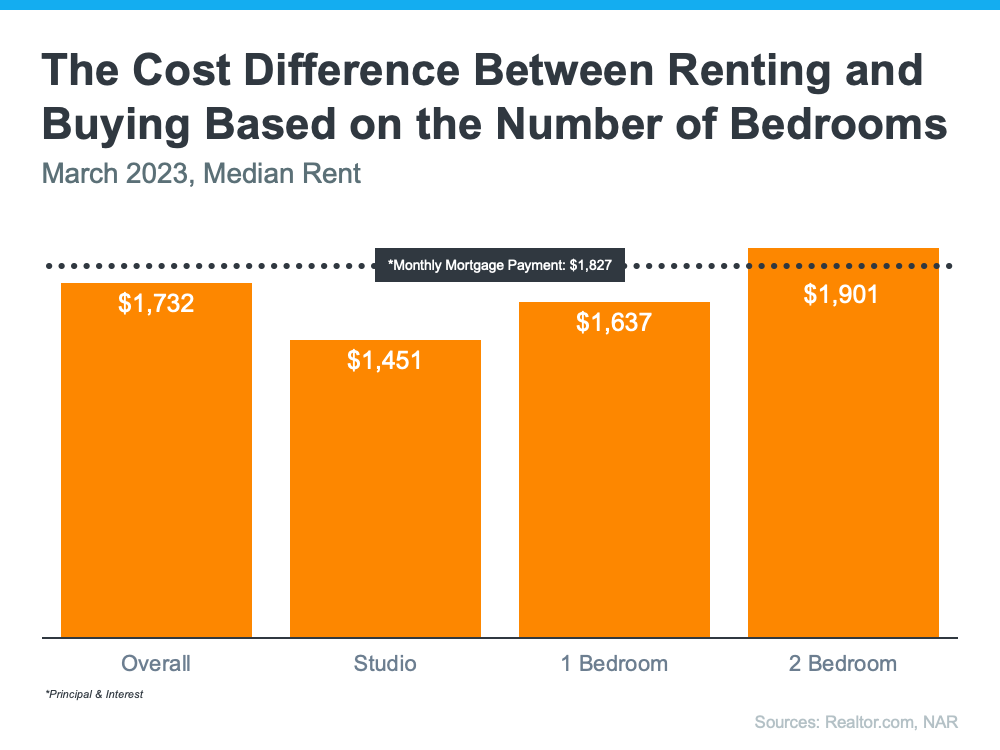
So, if you’re looking to live somewhere where you have two or more bedrooms to accommodate your household, give you more breathing room to spread out your belongings, or dedicate the extra space to practice your hobbies, it might make sense to consider homeownership.

Homeownership Allows You To Start Building Equity

In addition to shielding you from rising rents and being more affordable when you need more space, owning your home also allows you to start building your own equity, which in turn grows your net worth.

And, as home values typically rise over time and you pay off your mortgage, you build equity. That equity can set you up for success later on because you can use it to help fuel a move to an even bigger space down the line. That’s why, according to Zonda, the top reason millennial homeowners bought their home over the past year was to build their own equity instead of someone else’s.

Bottom Line

If you’re trying to decide whether to buy a home or continue renting, let’s connect to explore your options. With rents rising, it may make more sense to pursue your dream of homeownership.

Filed Under: Uncategorized Tagged With: cost difference, homebuying vs renting

What’s Ahead For Mortgage Rates This Week – May 1, 2023

May 1, 2023 by Bob Elliot

What's Ahead For Mortgage Rates This Week - May 1, 2023Last week’s economic reporting included readings on home prices, sales of new homes, and pending home sales. Monthly and year-over-year readings for inflation were published along with weekly reports on mortgage rates and jobless claims.

February S&P Case-Shiller Housing Market Indices show slower home price growth

National home prices continued to rise in February, but at a slower pace according to S&P Case-Shiller home price indices. Month-to-month home prices rose by  0.40 percent in February and matched analysts’ expectations, but were lower than January’s reading of  2.50 percent home price growth.

S&P Case-Shiller’s 20-city home price index, which is frequently used by real estate professionals for tracking housing markets, rose by 0.10 percent month-to-month in February.  This was the first time home prices rose in eight months.

The Federal Housing Finance Agency, which oversees Fannie Mae and Freddie Mac, reported an increase of  0.50 percent in home prices for homes owned and sold by Fannie Mae and Freddie Mac.Properties owned and sold by Fannie Mae and Freddie Mac are subject to loan limits and underwriting rules used by the two agencies.

In related news, the National Association of  Realtors® reported pending home sales fell by -5.20 percent in March compared to the expected reading of 0.50 percent growth and February’s reading of 0.80 percent in pending sales.

Mortgage Rates Mixed, Jobless Claims Fall

Freddie Mac reported mixed movement on mortgage rates as the average rate for 30-year fixed-rate mortgages rose by four basis points to 6.43 percent. Rates for 15-year fixed-rate mortgages fell by five basis points and averaged 5.71 percent.

Initial jobless claims fell to 230,000 claims compared to the expected reading of 246,000 claims and the previous week’s reading of 245,000 claims. Continuing jobless claims fell to 1.86 million filings from the prior week’s reading of 1.87 million ongoing claims.

The University of Michigan reported no change in consumer responses to its consumer sentiment survey for April. The index reading of 63.5 for March was unchanged in April and also matched analysts’ forecasts.

What’s Ahead

This week’s scheduled economic reporting includes readings on construction spending, the Federal Open Market Committee’s scheduled statement, and Fed Chair Jerome Powell’s post-meeting press conference. Readings on public and private-sector employment and national unemployment are also scheduled for release.

Filed Under: Financial Reports Tagged With: Financial Report, Interest Rates, Jobless Claims

Why Today’s Foreclosure Numbers Are Nothing Like 2008

April 27, 2023 by Bob Elliot Leave a Comment

You’ve likely seen headlines about the number of foreclosures climbing in today’s housing market. That may leave you with a few questions, especially if you’re thinking about buying a house. Understanding what they really mean is mission-critical if you want to know the truth about what’s happening today.

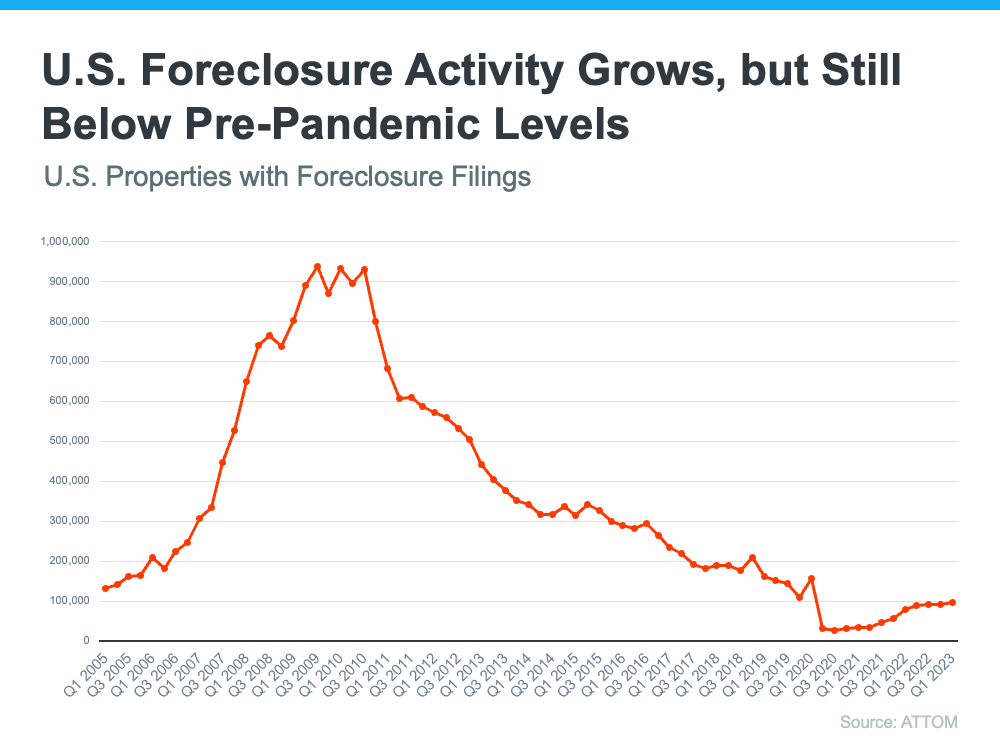
According to a recent report from ATTOM, a property data provider, foreclosure filings are up 6% compared to the previous quarter and 22% since one year ago. As media headlines call attention to this increase, reporting on just the number could actually generate worry and may even make you think twice about buying a home for fear that prices could crash. The reality is, while increasing, the data shows a foreclosure crisis is not where the market is headed.

Let’s look at the latest information with context so we can see how this compares to previous years.

It Isn’t the Dramatic Increase Headlines Would Have You Believe

In recent years, the number of foreclosures has been down to record lows. That’s because, in 2020 and 2021, the forbearance program and other relief options for homeowners helped millions of homeowners stay in their homes, allowing them to get back on their feet during a very challenging period. And with home values rising at the same time, many homeowners who may have found themselves facing foreclosure under other circumstances were able to leverage their equity and sell their houses rather than face foreclosure. Moving forward, equity will continue to be a factor that can help keep people from going into foreclosure.

As the government’s moratorium came to an end, there was an expected rise in foreclosures. But just because foreclosures are up doesn’t mean the housing market is in trouble. As Clare Trapasso, Executive News Editor at Realtor.com, says:

“There’s no reason to panic, at least not yet. Foreclosure filings began ticking up . . . after the federal foreclosure moratorium ended. The moratorium was enacted in the early days of COVID-19, when millions of Americans lost their jobs, to prevent a tsunami of homeowners losing their properties. So some of these proceedings would have taken place during the pandemic but got delayed due to the moratorium. This is a bit of a catch-up.”

Basically, there’s not a sudden flood of foreclosures coming. Instead, some of the increase is due to the delayed activity explained above while more is from economic conditions. As Rob Barber, CEO of ATTOM, explains:

“This unfortunate trend can be attributed to a variety of factors, such as rising unemployment rates, foreclosure filings making their way through the pipeline after two years of government intervention, and other ongoing economic challenges. However, with many homeowners still having significant home equity, that may help in keeping increased levels of foreclosure activity at bay.”

To further paint the picture of just how different the situation is now compared to the housing crash, take a look at the graph below. It shows foreclosure activity has been lower since the crash by looking at properties with a foreclosure filing going all the way back to 2005.

While foreclosures are climbing, it’s clear foreclosure activity now is nothing like it was during the housing crisis. In addition to all of the factors mentioned above, that’s also largely because buyers today are more qualified and less likely to default on their loans.

Today, foreclosures are far below the record-high number that was reported when the housing market crashed.

Bottom Line

Right now, putting the data into context is more important than ever. While the housing market is experiencing an expected rise in foreclosures, it’s nowhere near the crisis levels seen when the housing bubble burst, and that won’t lead to a crash in home prices.

Filed Under: Foreclosures Tagged With: Equity, Foreclosures, Home Prices

  • « Previous Page
  • 1
  • …
  • 48
  • 49
  • 50
  • 51
  • 52
  • …
  • 1133
  • Next Page »

Connect with Me!

Let’s Keep In Touch!

  • This field is for validation purposes and should be left unchanged.

Quick Links

  • About Me
  • Accessibility Statement
  • Blog
  • Contact

Looking For Something?

Categories

Copyright © 2025 · Powered by MySMARTblog

Copyright © 2025 · Genesis Sample Theme on Genesis Framework · WordPress · Log in