Minnesota Homes Today Local & National News

  • Home
  • About Us
  • Blog
  • Resources
    • Buyers Guide
    • Sellers Guide
    • Buyer Info
    • Seller Info
    • Closing Costs
    • Home Appraisal
    • Home Inspection
    • Loan Checklist
    • Loan Process
    • Loan Programs
  • Contact

10 Cities Projecting Home Value Increases Through 2013

June 18, 2012 by Bob Elliot Leave a Comment

10 cities poised for growth through 2013Nationwide, the U.S. housing market is showing signs of recovery. Home prices are rising as demand for homes outweighs existing home supply in many metropolitan regions.

As is customary in real estate, though, the degrees to which home values change vary by area.

In some U.S. markets, the housing recovery is outpacing the national average. In other markets, it lags. In an effort to measure the changes, CNNMoney has named the 10 U.S. housing markets in which home prices may rise the fastest.

The list is stuffed with small- to mid-size cities, most of which have experienced huge price drops since the housing market’s peak in 2007. The cities are gems, however, for the right type of home buyer. This may include real estate investors, first-time buyers, move-up buyers, and even parents with children in need of “college housing”.

As listed by CNNMoney, the 10 cities in which home values are rising fastest are :

  1. Madera, CA (Down 53.1% from peak; Forecast 21.5% gain through 2013)
  2. Medford, OR (Down 37.1% from peak; Forecast 20.1% gain through 2013)
  3. Yuma, AZ (Down 37.4% from peak; Forecast 16.7% gain through 2013)
  4. Corvallis, OR (Down 11.4% from peak; Forecast 13.2% gain through 2013)
  5. Eugene, OR (Down 21.2% from peak; Forecast 12.4% gain through 2013)
  6. Olympia, WA (Down 26.3% from peak; Forecast 11.3% gain through 2013)
  7. Boise, ID (Down 36.9% from peak; Forecast 11.0% gain through 2013)
  8. Billings, MT (Down 3.0% from peak; Forecast 10.1% gain through 2013)
  9. Lewiston, ID (Down 7.5% from peak; Forecast 10.0% gain through 2013)
  10. Sante Fe, NM (Down 17.1% from peak; Forecast 10.0% gain through 2013)

These 10 cities are more diverse in their make-up than their geography. All ten can be found in the western half of the United States. However, whereas some cities are expected to excel as a result of proximity of universities — Eugene and Corvallis, for example — others are expected to excel for economic reasons.

This includes cities such as Yuma, which is in a Foreign Trade Zone.

Real estate remains a local market, though, and even within these ten cities, there will exist neighborhoods in which growth exceed national averages, and areas in which growth falls behind.

For accurate, real-time real estate data in Minneapolis/St Paul , be sure to speak with a real estate professional. Minnesota Real Estate Today
Filed Under: Rankings Tagged With: CNNMoney, College Housing, Home Values

Foreclosure Filings Rise 9% in May

June 15, 2012 by Bob Elliot Leave a Comment

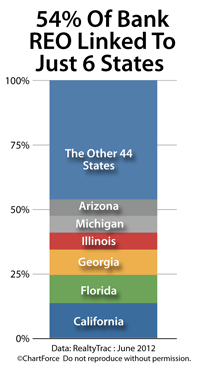
Foreclosure concentration June 2012

According to foreclosure data firm RealtyTrac, the number of foreclosure filings nationwide rose 9 percent in May as compared to April 2012. Filing topped 200,000 units for the first time in 3 months.

The term “foreclosure filing” is a catch-all term comprising default notices, scheduled auctions, and bank repossessions. On average, 1 in every 639 U.S. homes receiving a foreclosure filing in May.

As in most months, foreclosure activity was concentrated by state. Just 6 states accounted for more than half of the nation’s total filings.

Those six states were :

  1. California : 13.6% of all repossessions
  2. Florida : 11.0% of all repossessions
  3. Georgia : 9.8% of all repossessions
  4. Illinois : 6.6% of all repossessions
  5. Michigan : 6.5% of all repossessions
  6. Arizona : 6.3% of all repossessions

An interesting note, though, is that for the first time since February 2006, Georgia was the country’s most foreclosure-heavy state, displacing Nevada, which has dominated the foreclosure landscape for the last 5 years.

1 in 300 Georgia homes received a foreclosure filing in May. The national average last month was 1 in 639 homes.

At the other end of the foreclosure spectrum is Vermont. There was just 1 foreclosure filing for every 15,539 homes in The Green Mountain State last month.

Meanwhile, distressed homes remain in high demand with today’s home buyers, accounting for 28 percent of April’s overall existing home sales based on data from the National Association of REALTORS®. However, if your home purchase plans call for buying a foreclosed or bank-owned home, make sure you do your research first.

Buying bank-owned property is a different process as compared to buying a non-distressed home. The purchase contracts are different, the buyer-seller negotiations are different, and the homes are sometimes sold with defects. This can make it difficult to get a mortgage — or even impossible.

Before buying “distressed”, therefore, be sure to with a real estate agent. It’s good to have an experienced agent on your side to coach you through the process.

Filed Under: Housing Analysis Tagged With: Distressed Homes, Foreclosures, RealtyTrac

31 States Represented In June’s Improving Market Index

June 14, 2012 by Bob Elliot Leave a Comment

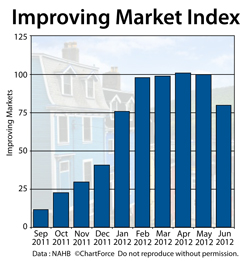
Improving Markets Index June 2012The number of U.S. housing markets showing “measurable and sustained growth” slipped by 20 in June, according to the National Association of Homebuilders.

The Improving Market Index is meant to identify housing markets in which economic growth is occurring as a whole — not just in the real estate space.

By using three separate, independently-collected data series, each tied to local economic conditions, the Improving Market Index takes a broader view of the housing market than other housing market indicators — the Case-Shiller Index, for example — which are often singularly tied to housing contracts.

The Improving Market Index tracks three distinct data series :

  1. From the Bureau of Labor Statistics : Employment statistics
  2. From Freddie Mac : Home price growth
  3. From the Census Bureau : Single-family housing growth

A given metropolitan area is categorized as “improving” by the National Association of Homebuilders if all three data series indicate growth at least six months after that area’s most recent economic trough.

In other words, the Improving Market Index looks past head-fakes of recovery, instead in search of long-term, sustainable growth.

This is one reason why its list of included cities is so fluid. It’s difficult for a metropolitan area to meet the Improving Market Index’s inclusion requirements month-after-month in a post-recession economy.

The Improving Market Index dropped to 80 in June, says the home builder trade group.

The list includes 28 new entrants, with forty-eight markets removed as compared to May. 31 states are represented nationwide.

For home buyers in Minnesota , the Improving Markets Index is a non-actionable report but it does do a good job of highlighting the local nature of real estate. For example, Columbus, Indiana was added as an Improving Market in June. Yet, Indianapolis, Indiana — located just 46 miles away — was downgraded from the same list.

Economies vary by locale.

The complete Improving Markets Index is available for download at the NAHB website. For a better gauge of what’s happening on the local level in Minneapolis/St Paul, though, talk to a local real estate agent. Minnesota Real Estate Today

Filed Under: Housing Analysis Tagged With: IMI, Improving Market Index, NAHB

  • « Previous Page
  • 1
  • …
  • 961
  • 962
  • 963
  • 964
  • 965
  • …
  • 1133
  • Next Page »

Connect with Me!

Let’s Keep In Touch!

  • This field is for validation purposes and should be left unchanged.

Quick Links

  • About Me
  • Accessibility Statement
  • Blog
  • Contact

Looking For Something?

Categories

Copyright © 2025 · Powered by MySMARTblog

Copyright © 2025 · Genesis Sample Theme on Genesis Framework · WordPress · Log in